

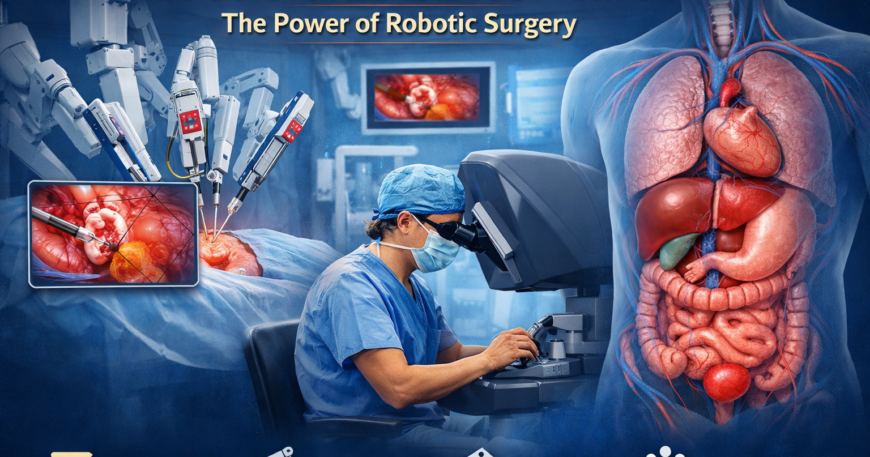
Precision in the OR: How Robotic Surgery is Changing Cancer Care

Surgery has always been at the heart of cancer treatment. Over the past two decades, the operating room has transformed — from large open incisions to keyhole surgeries and now, to precision-driven robotic surgery. Robotic surgery has allowed us to perform complex oncologic procedures with unmatched accuracy, safety, and patient comfort.
What Makes Robotic Surgery Different?
Robotic surgery doesn’t replace the surgeon — it enhances the surgeon’s ability. The robotic system acts as an extension of the surgeon’s hands, offering:
- 3D magnified vision for detailed view of delicate tissues and vessels
- Tremor-free instrument control with degrees of movement greater than the human wrist
- Enhanced precision in confined areas such as the Abdomen, pelvis, Thorax
- Smaller incisions, which mean less blood loss, less pain, and faster recovery
The result? A surgery that’s safer, smoother, and often shorter — with better preservation of critical anatomy and function.
Why It Matters in Cancer Surgery
In cancer care, every millimeter counts. Whether it’s preserving urinary and sexual function in pelvic surgeries, or minimizing blood loss during abdominal ,Uterine,kidney and prostate surgeries — precision determines outcomes.
Robotic platforms allow us to:
Abdominal and Pelvic organs resection— enabling detailed anatomy, preserving critical anatomical structures and nerves during the surgery
Prostate and kidney cancer surgeries — offering excellent oncologic clearance with faster recovery
Uterine and bladder cancers — where deep pelvic access is essential but challenging
Achieve shorter hospital stays and quicker recovery
Offer cosmetically better results with smaller incisions
Reduce postoperative pain and blood loss
These benefits together translate to faster rehabilitation and an earlier return to normal life — which matters deeply for cancer patients and their families.
Safety Through Standardisation
Technology alone doesn’t guarantee excellence — protocol does.
At Manipal Hospital, we follow a standardised, step-by-step surgical protocol that combines:
- Thorough preoperative planning with radiologic and multidisciplinary input
- Robotic docking and instrument setup optimized for each tumor site
- Real-time assessment of margins and critical structure preservation
- Postoperative enhanced recovery protocols (ERAS)
This structured approach ensures that each robotic surgery is performed safely, reproducibly, and with consistent outcomes — a philosophy I have strongly believed in and practiced over years of surgical experience.
Transforming the Patient Experience
For patients, the transformation is remarkable.
Instead of large incisions, prolonged drains, and extended hospital stays, they often experience:
- Mobilization within 24 hours
- Minimal wound-related complications
- Shorter hospitalisation (typically 2–3 days)
- A quicker return to routine life and work
These tangible outcomes build trust — and reinforce that high-end surgical oncology can be delivered with compassion, precision, and recovery in mind.
Beyond Technology: The Human Touch
Robotic surgery may be technologically advanced, but at its heart lies human judgment.
At Manipal Hospital, we combine innovation with empathy — ensuring that every patient receives not just cutting-edge care, but also personal attention and counseling at every stage of the journey
The Future Is Here — and It’s Minimally Invasive
Robotic surgery is not just a technological leap — it’s a shift in how we approach cancer care.
It brings together science, precision, and empathy to give our patients the best possible surgical outcomes with minimal disruption to their lives.
At the end of the day, the goal remains simple:
To perform the most complex surgeries with the gentlest touch.
